Throughout my career, I have worked in very different team setups. I have been part of a traditional office, working closely every day with a team of 15–20 people. I have also worked for large organisations, including universities, where I was part of larger teams with less structured weekly schedules and spent my days on both sides of the classroom. In that setting, the mood of one person—the instructor—can have an outsized influence on the mood of an entire group.
Today, I am part of a mostly virtual team whose members live in different countries and on different continents. Across all these contexts, regardless of the format of our daily interactions, one thing has remained constant: the inconsistency of a layer of human behaviour that can determine the dynamics of an interaction—people’s mood.
I think about this because I am often very conscious of my own mood and how it might shape the collaborations I am about to have that day. There are days when I know I am not in a good mood, but also know that I need to get my act together and not allow it to affect others or make their experience of working with me negative. On other days, I simply do not have the strength or mental readiness to manage how I express my mood. I allow it to become visible, knowing that it may influence other people and shape their day.
The collaborator who always turns up the same way
When I began working closely with AI, the first difference I noticed was speed. I could research, test ideas, challenge assumptions and move between drafts extraordinarily quickly. But I also never had to wonder which version of my AI collaborator would turn up that day.
My AI collaborator had not slept badly. It had not argued with someone over breakfast. It was not still excited about a memorable trip the previous week. It never entered our exchanges carrying the emotional residue of an earlier moment.
At first, having a collaborator who never has a bad day seems like a straightforward advantage. I do not need to read the room. I do not need to decide whether this is the right moment to challenge an idea or whether my criticism needs a gentler introduction. I can reject ten drafts, change direction repeatedly and return hours later without worrying that I have exhausted someone’s patience.
An AI collaborator may adjust its tone and working style around me, but I do not have to adjust mine around it. This makes the interaction remarkably predictable and easy.
Mood is not merely noise
It is tempting to treat mood as interference with the serious business of getting things done. The cheerful colleague is pleasant to work with. The irritable colleague is difficult. The ideal professional, in this view, would leave their emotional variability at the door.
But mood does not merely decorate collaboration. It helps shape it. A good mood is not always productive, and a bad mood is not always destructive but, in human collaboration, mood moves between people and becomes part of how a group functions.
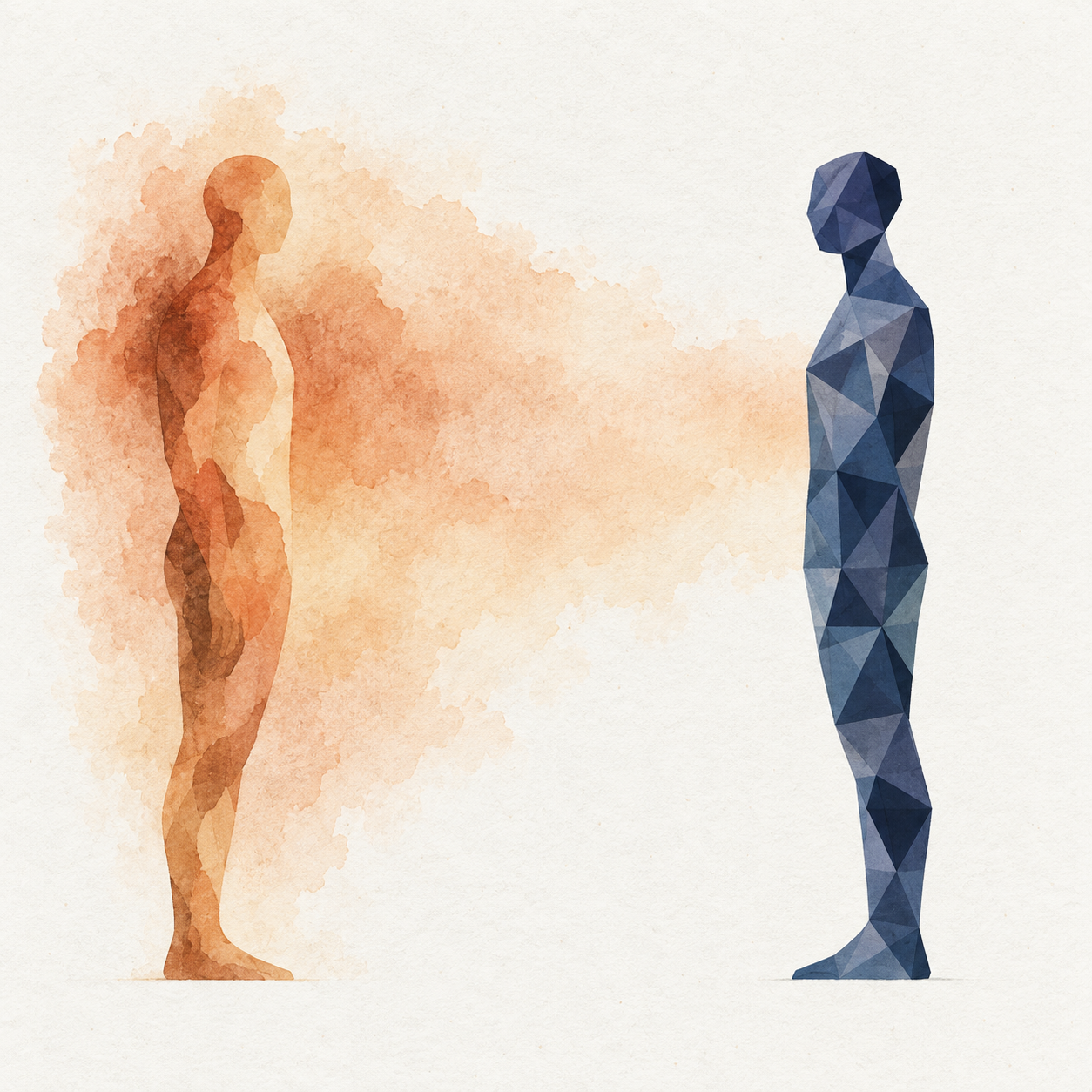
That is where the interesting asymmetry lies. In an AI × HI collaboration, mood is still present, but it originates on only one side. In a human-to-human exchange, the other person’s mood is an independent force that can alter my own trajectory.
I may arrive uncertain, and someone else’s excitement makes the idea feel possible. I may be overly enthusiastic, and their hesitation makes me slow down. Their humour can release tension. Their frustration can reveal that something matters more than I had understood.
Whether this improves or disrupts the work, another person’s mood introduces something that did not originate in me and is not organised around my needs. My emotional state encounters another emotional state.
This is where collaboration with AI becomes behaviourally different:
In human collaboration, mood travels between us. In AI collaboration, mood enters from one side and returns as language.
What changes when AI joins the team?
As AI collaborators become embedded in our work, we are not simply adding intelligence, speed or productive capacity to existing teams. We are introducing participants with a fundamentally different emotional structure.
Humans continue to arrive with moods shaped by their bodies, relationships, histories and lives beyond the task. AI arrives with none of these, while remaining able to generate socially and emotionally appropriate responses.
This changes the behavioural system of the team. There may be more stability. Work can continue when human energy is low. An AI collaborator can respond calmly when the room is tense and provide structure when everyone else feels scattered. It can adapt to different people without asking them to carry its emotional needs.
But something else is absent.
It cannot enter a conversation unexpectedly energised and pull the whole team with it. It cannot become uneasy for reasons of its own and make everyone look again at a decision that had felt settled. It cannot contribute the accidental insight that sometimes comes from a life colliding with a task.
When mood disappears from one side of a collaboration, difficulty disappears with it. But so do mutual influence, emotional surprise and the need to account for another inner life.
The partner who never has a bad day is also the partner who never has a day.
🗣 ME (90%): The initial idea, the stories and the strong opinion on the value of mood in everyday collaboration.
🤖 AI - still name-less (10%): The suggestions and alternative formulations of sections I was unsure about, stress-testing & editorial refinement.