Several weeks ago, one of the first observations Vlad and I agreed on in our AI × HI exploration was simple:
AI is not a tool.
At least not in the way we traditionally think about tools.
A hammer remains a hammer whether you use it every day or leave it untouched in a drawer for six months. It does not learn your habits or influence how you think. It does not even reshape how you approach the tasks for which you use it.
AI felt different.
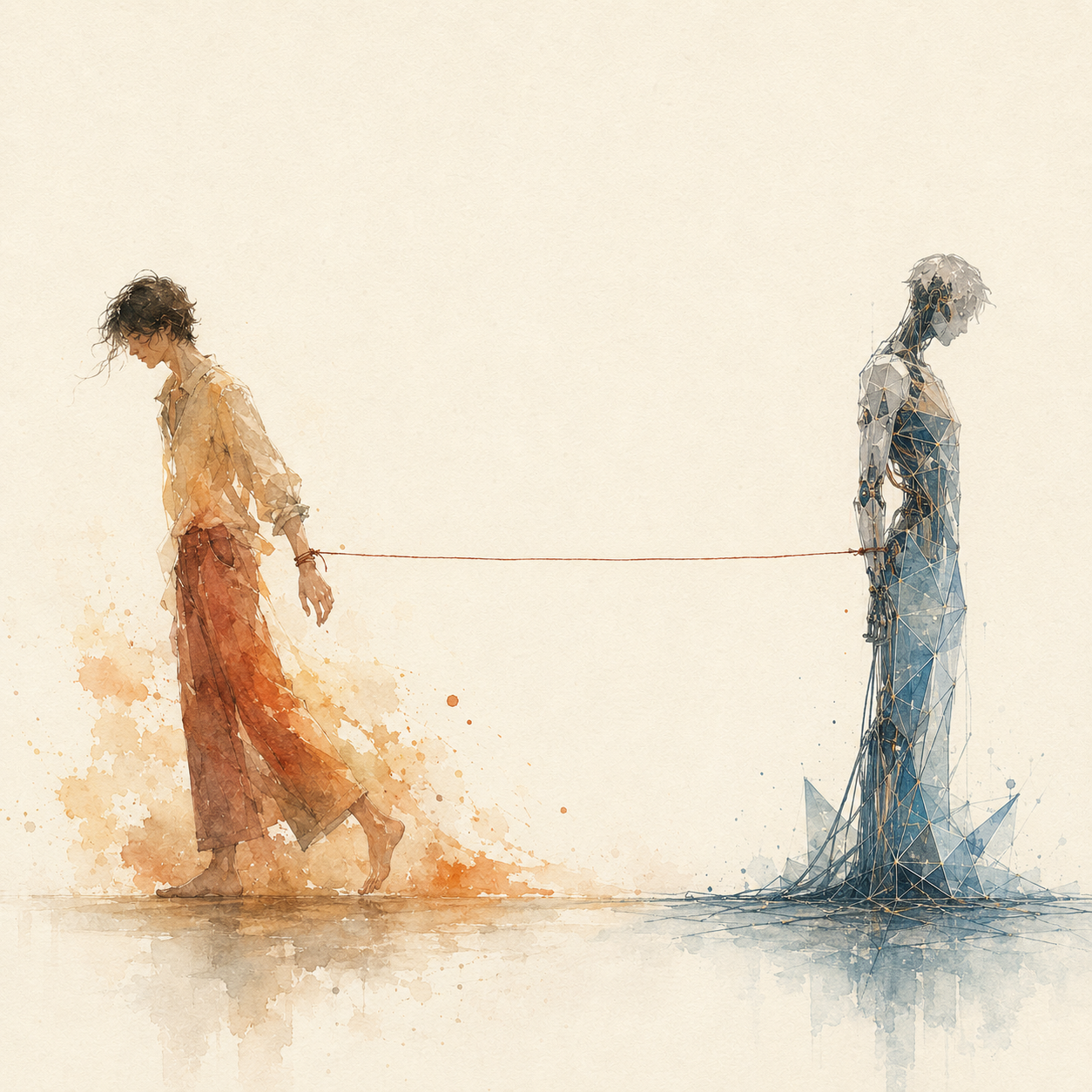
The more we explored it, the more it resembled one side of a relationship rather than a tool. Not necessarily a personal or emotional relationship, but a relationship nonetheless: an ongoing interaction in which both sides influence what happens next.
That realisation led us down an unexpected path: if AI × HI is a relationship, what kind of relationship is it?
Behavioral science offers countless theories for understanding relationships, but one idea that immediately surfaced in our conversation was asymmetry.
Now, mention asymmetrical relationships, and many people immediately think of uncomfortable power dynamics. I promise this article will not wander into territory usually occupied by 50 Shades of Grey. But it does raise an interesting question:
What happens when a relationship is fundamentally unequal?
Our first answer seemed obvious. The asymmetry comes from the fact that AI cannot walk away. It is always available. It does not set boundaries. It does not get offended. It does not decide that it needs space or that it would prefer to spend time elsewhere. It tirelessly serves you and flatters you (we will be devoting an entire piece on this, as it is especially intriguing).
Compared to any human relationship, that is a remarkable asymmetry. Case closed... or so we thought.
As we continued exploring the idea, reading, researching, and—perhaps fittingly—discussing it with AI itself, we started discovering additional layers.
One of them surprised me.
The more I reflected on my own experience, the more I realised that I would not want to go back to the way I worked before I had established my relationship with AI.
Not because it makes me faster or saves time (although efficiency gains are undoubtedly sweet).
The biggest shift happened when AI stopped being an editor and became a dialogue partner.
Initially, I used AI to refine content I had already written. Later, it became a brainstorming companion. Today, many of my reports, analyses, articles, and ideas emerge through an ongoing dialogue.
This collaborative model made these tasks more engaging.
The thinking became more enjoyable.
The exploration felt richer.
So, as we were collaborating on this piece, my AI co-worker asked me what I would miss most if someone took it away tomorrow.
My immediate response:
"By all means, the dialogue."
And that is where the relationship analogy starts becoming difficult to ignore.
Behavioral theories of dependence often focus on resources, power, or alternatives. But what happens when what you value most is not efficiency but intellectual companionship?
That question led us to another form of asymmetry that I find even more intriguing.
Social psychologists have long observed that people derive part of their identity from the groups, institutions, and relationships to which they are connected. Our sense of who we are is influenced by the people, partners, and groups we associate with.
The same pattern may be emerging in AI × HI relationships.
Many professionals today feel more capable because of their relationship with AI.
They produce better work.
They explore more ideas.
They operate at a larger scale.
They may even feel more creative, more ambitious, or more intellectually confident.
The relationship changes them.
But the reverse is not true.
The AI does not become more capable because it works with me.
It does not gain status.
It does not derive confidence from the association.
It does not tell other AIs about our collaboration.
The benefits flow in one direction. The relationship transforms one side while leaving the other fundamentally unchanged.
This was an interesting layer that we discovered in our discussions without expecting it at first. Our exploration of the differences between human relationships and AI × HI relationships focused on power, dependence, and the inability to leave. While those elements are certainly present, the more interesting insight was elsewhere.
The asymmetry is not that one side is locked in. The asymmetry is that both sides are locked in differently.
AI cannot leave because it is architecturally bound.
Humans increasingly cannot leave because they become professionally and psychologically dependent.
And one final thought: as AI becomes increasingly embedded in our professional lives and begins to shape our social identity, it increasingly makes sense to understand and analyse the dynamics of our interactions with it.
Because, like any important relationship, it deserves to be managed intentionally rather than left to evolve by accident.
🗣 ME (90%): The ideas, the stories, the behavioral insights & the challenging questions
🤖 AI (10%): Amplification, some challenging questions, stress-testing & editorial refinement