It started as a joke.
We were in a work conversation discussing an idea when one of us shared her thoughts and casually explained that they were the result of some work by "me, myself, and Aireen."
Aireen, of course, was her AI.
The comment made everyone smile. It was witty, natural, and somehow immediately understandable. Then Vlad, who was part of the discussion, mentioned that he, too, had given a name to his main AI collaborator.
That triggered a question.
Why do we do that? Not because AI needs a name. It doesn't.
We do.
At first glance, naming your AI feels surprisingly practical. Instead of saying, "I asked AI," or "ChatGPT suggested…", suddenly there is continuity. The relationship feels more personal, more stable, almost like referring to a trusted colleague with whom you have developed a shared way of working.
And perhaps that is exactly why it deserves a little more thought. On one side, it feels natural for us to want to identify our AI collaborator as something different from a "generic AI"—an AI that has a history with us and has, in some ways, been shaped by our interactions.
On the other side, the behavioral lens in me cannot help but wonder whether giving our AI a name is just a harmless habit or whether it has psychological implications we should bring to light. What if it is one of the behavioral design decisions we make in our AI × HI relationship?
Just starting to think about this made me realize that this topic reveals another AI × HI asymmetry—that the name changes nothing about the AI, but it might have an effect on us. Or rather, on our AI × HI relationship.
Why is this so?
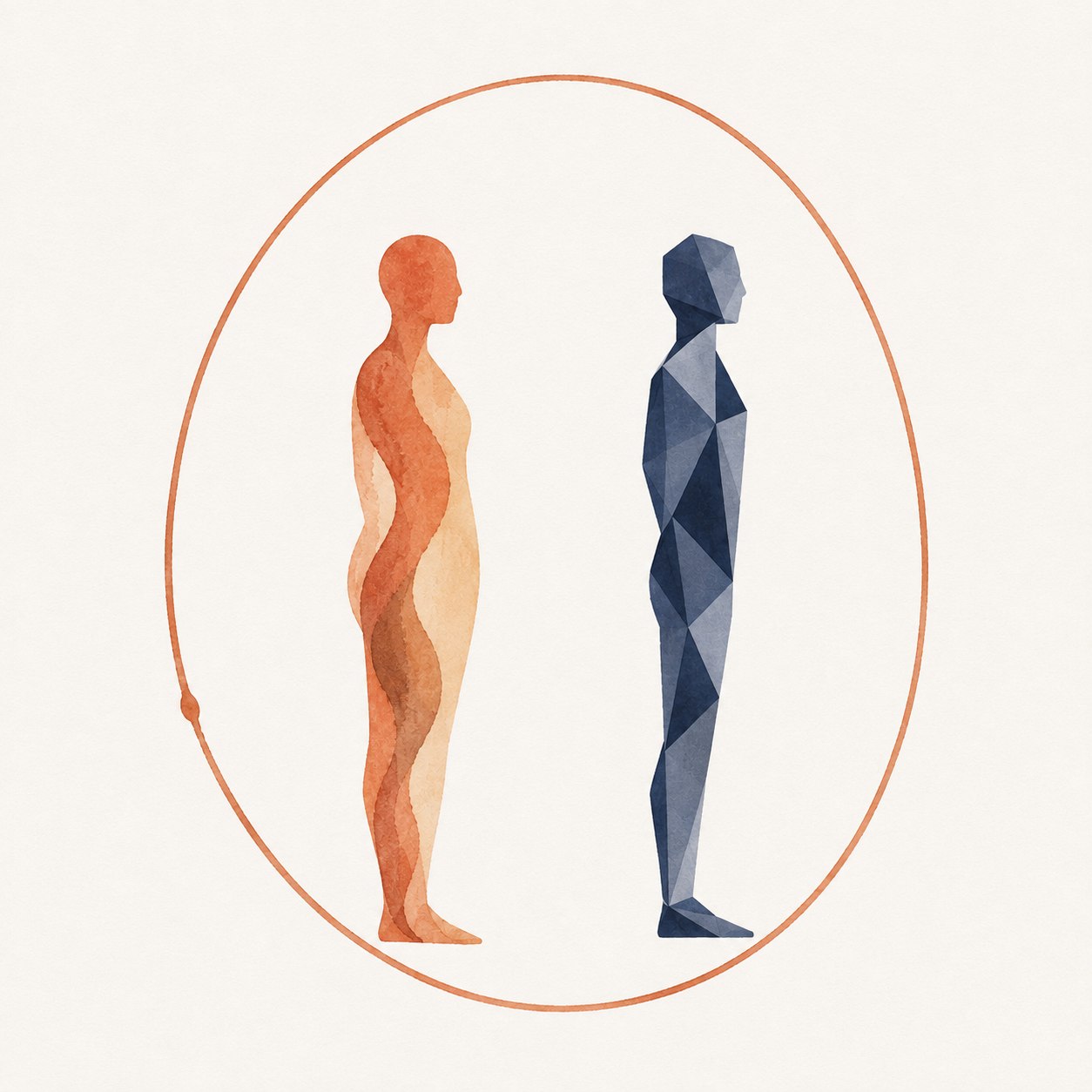
When we name another human being, we are recognizing an identity that already exists. When we name our AI, we are actually creating one.
Behavioral science explains that people naturally apply social rules to technologies that display human-like cues. A name may be one of the strongest cues of all.
And once an identity exists, our social instincts quietly begin filling in the blanks. "Aireen is good at strategy." "Finn is great at spotting patterns." "Ella understands how I think."
As a result, AI has not become more human, but our mental model of the relationship has.
So, does that mean that naming your AI is a mistake?
No, I suspect the opposite.
As AI becomes a genuine collaborator rather than an occasional tool, continuity matters. Shared history matters. A stable relationship matters. Perhaps giving that relationship a name is simply our way of acknowledging that something has changed.
But if a name shapes identity and frames the AI × HI relationship, should we design it more intentionally?
Most people instinctively choose human names.
Sarah.
Emma.
David.
Those names make collaboration feel natural because they activate the same mental models we use for human relationships—and that becomes another behavioral trap.
Perhaps, instead of choosing names that make AI feel more human, we should choose names that remind us we are building a partnership that is different from a human-to-human relationship.
Compass.
Echo.
Loom.
Prism.
Names that create continuity without creating confusion. Names that remind us this collaborator is neither simply software nor another person, but something new that deserves its own mental model.
Of course, even these names may eventually acquire personalities of their own. The goal is probably not to eliminate anthropomorphism entirely (our natural tendency to attribute human qualities, intentions, and personalities to non-human things), but to shape the relationship more intentionally.
The question becomes even more interesting—and more complex—when we place it in the context of teams and organizations.
As AI becomes a normal part of every professional team, what should we normalize? Should organizations encourage people to give their AI collaborators AI-specific names or human names? Should those names remind us that these are different kinds of partners with different strengths, different limitations, and different responsibilities?
There is another possibility we have not yet considered.
Instead of giving AI a completely independent identity, perhaps we should name the partnership itself—or make the human connection explicit.
Compass (Milena)
Milena AI
Team Milena–Compass
That would preserve something important: the reminder that every AI collaborator is also shaped by a human collaborator. Two people may both work with the same foundation model, but they are not working with the same AI. Their prompts, history, context, and ways of thinking gradually create different collaborators.
Perhaps our naming conventions should make that relationship visible rather than invisible.
At this point, you are probably wondering whether I have a name for my main AI collaborator.
I do not.
But now I am convinced I should have.
I will take a little more time to decide what it should be—and what kind of relationship I want that name to shape.
Perhaps, before long, my own ideas will no longer come from "me, myself and I."
They will come from me... and whoever my AI collaborator becomes.
🗣 ME (90%): The idea, the behavioral read, the story and the hesitation in coming up with an AI name.
🤖 AI - still name-less (10%): The (flattering) feedback, some brainstorming questions, stress-testing & editorial refinement.