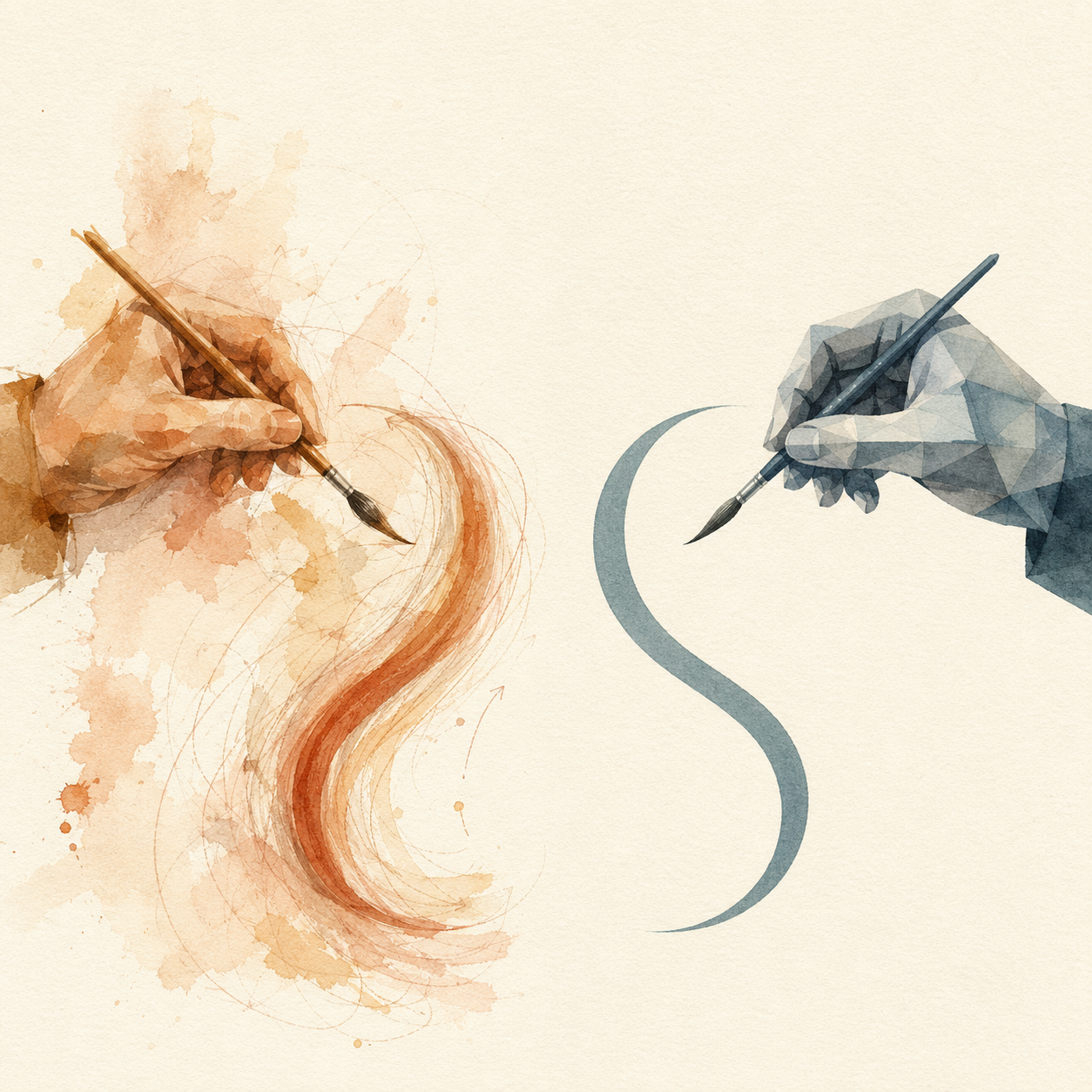
One of the main assumptions we make about bringing AI into our professional lives is that it saves us time.
Need a presentation? AI drafts it.
Need a report? AI writes it.
Need an image? AI generates it.
And in many cases, it genuinely does.
But things appear to be less simple than that. What if, when AI saves us time and effort, it is also saving us from the parts of creation that matter most?
Time to uncover the next asymmetry in the AI × HI relationship – that only one participant enters it capable of personal growth.
AI can produce. Only humans can become something more as a result of it.
For most of history, producing something and developing ourselves were inseparable. If we wanted to create something meaningful, we had to...
think,
question,
experiment,
iterate,
reject ideas.
The effort was rarely just about producing an outcome. It was also shaping the person doing the creating. In essence, every meaningful act of creation has two outcomes:
Something we create.
And someone we become.
AI changes that relationship. For the first time, production and development can become separated.
We can produce…
...without necessarily becoming.
Why is this separation behaviorally interesting?
I was reminded of it while teaching an MBA course recently.
At the start of the course, I encouraged my students to use AI throughout their work. The only requirement was that they be transparent about how they had used it. Most described AI as an editor, a thought partner, or a way to improve language, analyse data and polish presentations—all supporting roles in an intellectual or creative process.
Some presentations, however, revealed something else. They looked excellent, clear, professional. Yet they rarely moved beyond familiar ideas. Their thinking was polished—but rarely surprising.
So some clearly relied far more heavily on AI than their descriptions suggested. The problem with this was not that AI had produced mediocre work. It had simply amplified mediocre thinking.
And this is where the interesting asymmetry lies.
AI does one thing remarkably well. It amplifies whatever enters the relationship.
If our thinking is shallow, AI scales shallow thinking.
If our thinking is original, AI scales originality.
This is where I think many of us fall into a subtle behavioral trap. We assume AI is replacing our effort. In reality, it is shifting where our effort belongs.
AI saves time. It does not save involvement.
Time is what AI gives us. Involvement is still a choice we have to make.
AI can remove effort from production. It cannot remove involvement from growth.
The developmental part of creation—the questioning, connecting, judging and imagining—is still ours. Whether we stay involved in that part is becoming an increasingly intentional choice.
I have to acknowledge that this thought about involvement was originally triggered by a conversation with my teenage daughter. She has a strong opinion against using AI to replace creative work. Interestingly, her focus is not on the lost job opportunities but on the superficial nature of the output because it bypasses effort, time, iteration and exploration.
Let me illustrate.
Imagine two people who end up with exactly the same tattoo design. One spends weeks working with a tattoo artist. They sketch, talk, discard ideas and discover meanings they hadn't considered. Slowly, the design becomes deeply personal—not simply because of what it looks like, but because of the journey that shaped it.
The other generates dozens of options with AI in a few minutes and chooses one.
The tattoo might be identical but I wonder… Years later, whose journey becomes part of the memory? Who remembers not only the tattoo, but the conversations, the uncertainty and the moments of discovery? Who was changed by creating it?
My daughter's point is obviously not about tattoos. Or even about AI. It is about involvement and the imprint it leaves on us—on our personal growth and development.
Perhaps that is the developmental asymmetry of AI × HI.
AI participates in creation. Only humans develop through it.
So, when we are intentional about our AI × HI symbiosis, the important question is no longer:
"How much work can AI do for me?" It is:
"Which parts of the creative journey are too valuable—for my own development—to outsource?"
The greatest opportunity AI offers us is not producing more with less effort.
It is becoming more intentional about the parts of creation that are worth remaining involved in because they are the very parts that change us.
🗣 ME (85%): The ideas, the reflections and the stories, the behavioral perspective.
🤖 AI (15%): The feedback, some brainstorming questions, stress-testing & editorial refinement.