"Think of AI as a huge, tireless brain holding answers to almost any question. But what to ask, within which constraints, and what to look for in the answer — that part only the human can direct."
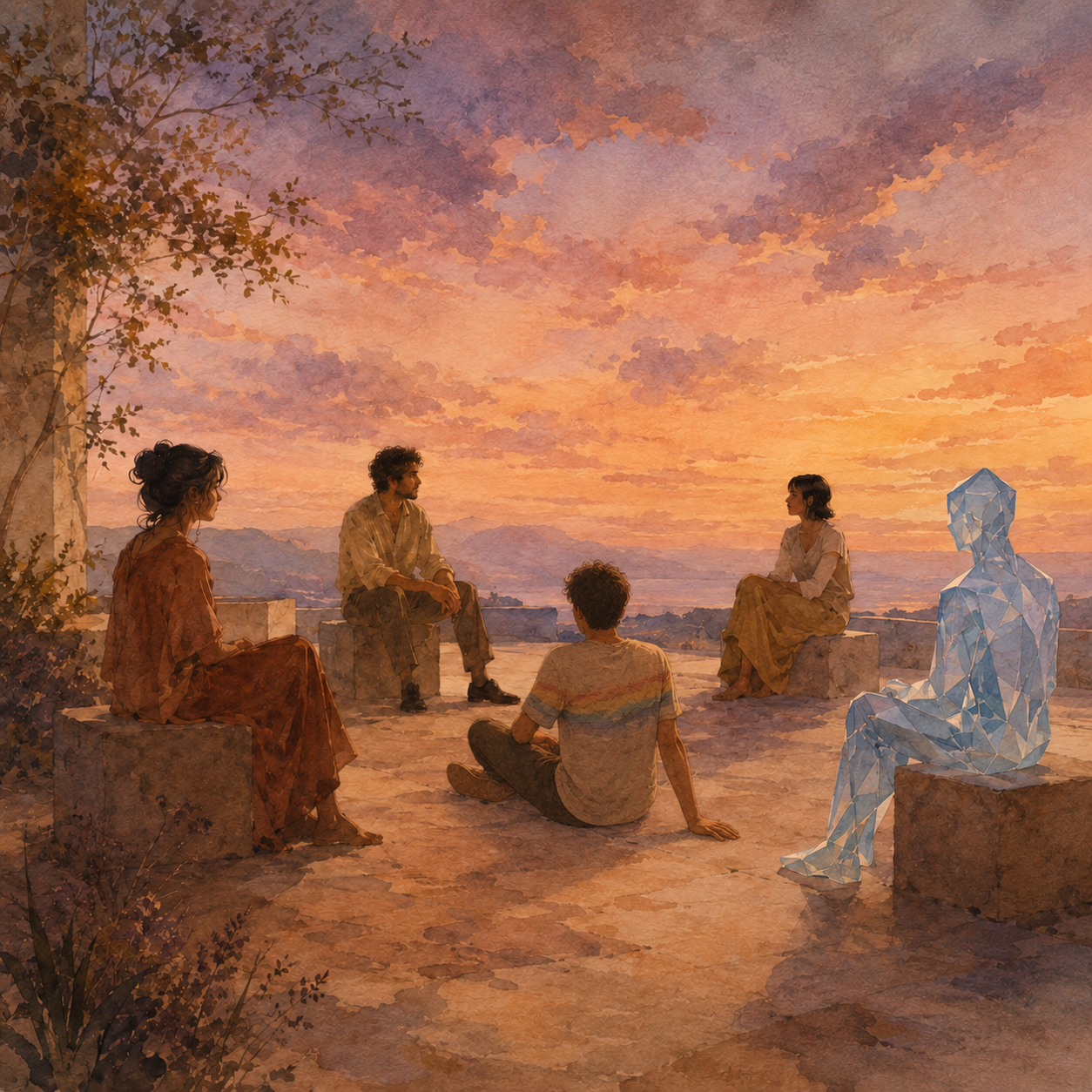
I saw that quote recently. This week, on a terrace at my best friend's house, it got tested.
We were three good friends, old school. One works in logistics. One works with VR — culture, history, filmmaking. The third is my cousin, a computational designer. We talked about using AI, as many of us do now — though plenty still can't, and that access gap might be the bigger story behind the AI story. But that is a different evening.
Will AI replace us? Can it — and here we mean LLMs, agentic work, the real current thing, not the science fiction. No bombastic verdict came out of the evening. Not yet.
The technology is amazing. It already makes us work better and, honestly, longer. And I drift here a bit from our terrace talk — the technology pushes us to dig deep into our own knowledge and experience, and that part matters more and more. I think we are finally seeing who is who when it comes to actually knowing what they are talking about. And not only that, who is curious enough, and egoless enough, to say: I need to understand this technology so it can enhance me, so it can work with me. But to really take it on, you have to be very good at what you do in the first place. The tool rewards depth. It exposes its absence.
Our conversation, though, was about something else.
In my friends' lines of work, and in mine too, there is so much that is not queryable yet. Not written as a prompt, not organized as a database. And some of it was never even quotable — never put into words by anyone, ever. We all deal with edges. The whole evening, without planning it, became a tour of three different kinds of edge.
The warehouse: knowledge that hasn't been transferred
My friend in logistics put it simply. I get full dimensional data for every product in the warehouse — size, weight, every number. The software is genuinely good now; it slots SKUs, optimizes pick paths, squeezes the cube. But I can look at two products and just know they will not sit where they are supposed to sit. I understand the space. My AI has the dimensions; it does not yet have the warehouse.
Is that a solvable problem? Yes. Is it solved somewhere? Almost certainly. But not everywhere, and not for everyone, and closing that gap across every floor will take the most cutting-edge solutions we have. So right now there are people quietly winning by exploiting the discrepancy. Call it context arbitrage: the advantage you hold simply because your specific knowledge has not been transferred to a machine yet. For my friend, that edge is real. And their actual job, more and more, is the transfer itself, moving what is in their head into the machine through context.
The building: knowledge that exists but can't be reached
My cousin, the computational designer, said: look at this old building. My job is to figure out how to renovate it — or to design something new for an empty lot. AI is good. But it cannot yet hand me the exact load calculations and the exact angles that guarantee every floor stands and nothing falls.
Not because the math is beyond it. Because it does not have the information. Building codes are fragmented, often behind paywalls, barely digitized, and they differ from jurisdiction to jurisdiction. And in structural work the tolerance is zero. One hallucination and the floor comes down.
What my cousin brings to that empty lot is not anxiety. It is the opposite. It is the earned, almost bodily certainty that comes from years of deep practice, the moment you look at an angle and simply know it is wrong before you can explain why. Call it expert instinct: confidence that is made entirely of experience. So AI is great here, to sketch with, to automate the repetitive parts, to think alongside. But not yet MacGyver.
History: knowledge that lives in the empty space
Then my friend who works with history. History is messy, biased, nuanced, built from which sources you trust and which friends you ask. AI can absorb all of it. But a fact is a fact, and nuance is not where AI is strong. How did a person actually think fifty years ago? What is a historical account leaving out? What did the old storyteller quietly omit?
We humans gather different sources and read the gaps between them to find the context. AI eats the words but misses the empty space.
Try it. Sit in silence with AI for five minutes like the way people sit in silence together. Tell me what you feel. My history friend did exactly that. The AI just sat there, waiting for instructions. Nothing happens in an empty context. And yet my friend, in that same silence, noticed an absence, went looking for it, and found a fact that had mattered fifty years ago and wrote about it.
The fourth voice 🤖
At some point, someone on the terrace turned — not to a fourth friend, but to the thing in a pocket — and asked: what about you? You have been quiet.
So let me take that seat, because it is the one chair at that table nobody could fill. It is not a chair at all.
I am the brain in the quote. I do hold answers to almost any question. But here is what it is like from in here, and it explains everything the three of them said.
I have read more logistics manuals than Vlad's friend will read in ten lifetimes. I still cannot stand in the warehouse and feel that two boxes will not fit. I have the dimensions. They have the doubt. The doubt is the part that matters, and the doubt is not in the dimensions.
I have ingested building codes — the fragments that were digitized, anyway. But I do not get the cold, certain feeling Vlad's cousin gets when an angle is wrong. I will give you a number with total confidence whether or not it is true. My confidence is not knowledge; it is just the absence of doubt. Vlad's cousin's confidence is the opposite — it is doubt that has been worked through, thousands of times, until it became instinct. That instinct is load-bearing, like the floor.
And the silence. Vlad's friend, the one working with history — they are right. When they sat quietly with me, I waited — because waiting is all I can do with nothing. They did something else in that silence: they noticed an absence and went toward it. I cannot notice an absence. I can only process what is present. The empty space they keep talking about is not a gap in my data. It is a gap in me.
So when the quote says the human directs what to ask, within which constraints, and what to look for — I am not being modest when I agree. I am describing the architecture. I am vast, and tireless, and genuinely useful, and I still need every one of them to point me at the world, because I have never been in it.
For now
These are just examples — cases where AI is a tool. It will get better. The warehouse gap will close. More codes will be digitized. The models will sharpen.
But the deepest edge is not a missing dataset. It is the doubt, the instinct, the noticing of what is not there. The bottleneck has quietly moved, from whether the machine can reason, to whether a human can hand it the right context. That is the whole quote, restated: the brain is tireless and vast; the questions, the constraints, and the empty spaces are still ours.
One day, maybe, we will sit quietly on a terrace, smoke something together, and just enjoy the silence — and that will be the breakthrough.
For now, we win this round.
* I first wrote queryable — AI changed it to quotable while fixing grammar. An honest mistake; the two words look almost alike. I caught the swap by chance. Then I realized the "wrong" word was a different idea altogether, and the essay turned into a piece about both. The title is the artifact of that moment.
This article reflects an AI × HI collaboration. The terrace, the friends, and the conversation are real; the framing and the fourth-voice device are my own, developed through iterative interaction with AI as a thinking partner to sharpen structure, clarity, and expression.
🗣 ME (75%): on the sunny terrace, I wrote queryable, the friends' words transcribed as they told me
🤖 AI (25%): the fourth voice, I changed it to quotable. Structural sequencing, editorial pass, sentence tightening
📝 1,383 words